
Tank Construction
One of the company’s priority areas is tank construction. 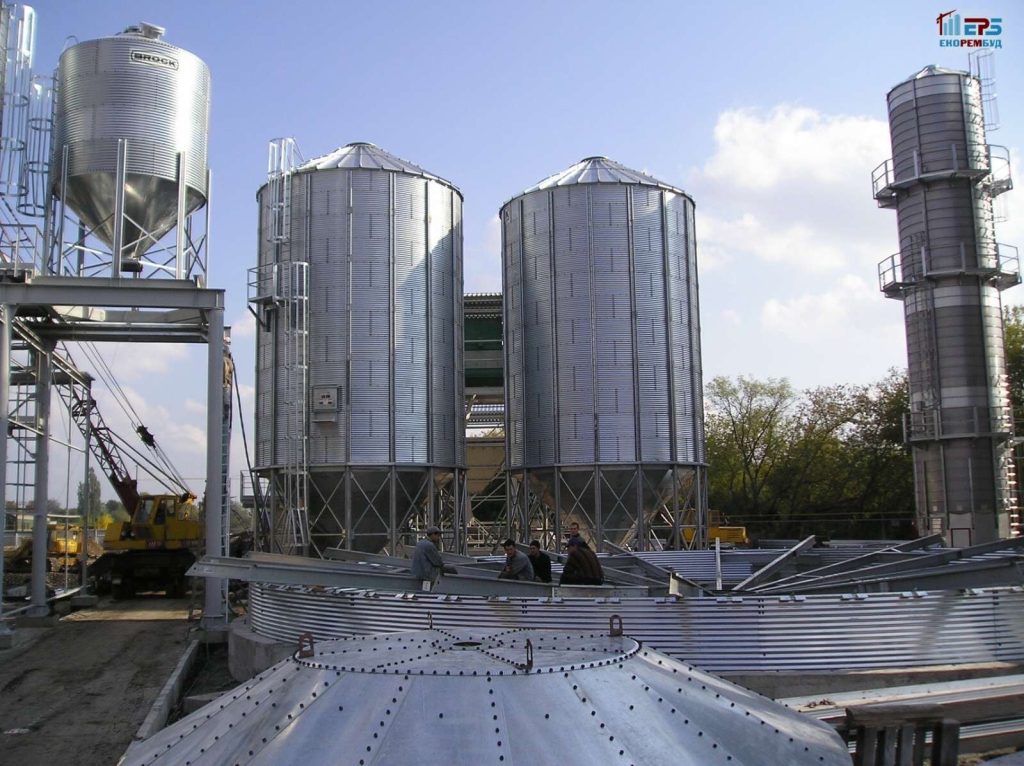 The enterprise’s equipment with modern welding and lifting machinery, as well as qualified personnel, allows for the installation of tanks with volumes up to and exceeding 100,000 m³, featuring double walls and a “floating” roof.
Tank Installation Methods
Various methods are used for tank installation:
“Roll” method. This method is relevant for tanks with a volume of no more than 3,000 m³. It is the oldest method and is gradually losing relevance due to new technologies, falling behind both in quality and cost.
“Block” method. Developed jointly by LLC “Ecorembud” and the E.O. Paton Electric Welding Institute. It is used for tanks of any capacity. Especially effective in repairing the first three rings of tanks with volumes from 10,000 to 50,000 m³ for storing oil and petroleum products. It was applied for repairing 20,000 m³ tanks at Lysychansk refinery (TNK) and installing 20,000 m³ tanks at a refinery in Ivano-Frankivsk region, Nadvirna city.
“Sheet” method. Currently the most relevant installation method. First used in the USA and later spread across Europe. Its main feature is a welding unit for double-sided welding of horizontal seams, which allows abandoning the “roll” and “block” methods, providing high-quality welding of horizontal seams directly on the construction site. Ecorembud purchased two AGW-II units from “Lincoln Electric” in the USA. One successfully passed testing in 2004 at the “PAK Terminal” site (Estonia) during the fabrication of four tanks with a volume of 30,000 m³.
The company also modernized the “sheet” method. Together with the E.O. Paton Institute, the AD-333 unit for automatic welding of vertical seams was developed. For 8 years now, this unit has shown excellent results and is also suitable for the “roll” method.
Implemented Projects
Various tanks have been constructed for different purposes:
- Installation of 4 tanks V=10,000 m³ in Sevastopol (petroleum products);
- Installation of 8 tanks V=2,000 m³ in Yuzhne, Odessa region (tropical oils);
- Installation of 12 tanks V=3,000 m³ in Klevan, Rivne district (petroleum products);
- Installation of 3 tanks V=10,000 m³ in Smyha, Dubno district (petroleum products);
- Installation of 2 tanks V=20,000 m³ in Nadvirna, Ivano-Frankivsk region (petroleum products);
- Installation of 2 tanks V=10,000 m³ in Chervonozavodske, Poltava region (molasses);
- Installation of 5 decomposers V=3,600 m (wall thickness 40 mm) at Mykolaiv Alumina Plant;
- Installation of 5 tanks V=4,500 m³ for storing palm oil in Yuzhne, Odessa region;
- Installation of 1 tank V=25,000 m³ in Voronezh region (Russia) at Olkhovatsky sugar plant (for molasses);
- Installation of a tank park V=24,000 m³ in Kherson (sunflower oil);
- Installation of tanks RVS-700m, RVS-3000m, RVS-35000m, RVS-10000m at NPS-1 Vankor field, Tyumen region (Russia);
- Installation of tanks RVS-10000m – 5 pcs, RVS-20000m – 2 pcs at LLC “RN-Tuapsenefteproduct” in Tuapse (Russia);
- Installation of tank RVS-10000m at “UPSV-North” – II launch complex in Novy Urengoy (Russia).